What Is an Institutional Trading Platform and How Does It Differ from Retail?

- Introduction
- What Is an Institutional Trading Platform?
- Institutional vs. Retail Trading: Key Differences
- Who Uses Institutional Trading Platforms?
- Core Features of an Institutional Trading Platform
- Execution Management Systems: The Engine Behind Institutional Trading
- What Brokers Need to Know When Serving Institutional Clients
- How to Evaluate an Institutional Trading Platform
- Frequently Asked Questions
When a hedge fund places a $50 million order in the forex market, it doesn't work the same way a retail trader placing a $5,000 trade does. The technology behind it, the execution logic, the risk controls, the data infrastructure — everything operates at a different scale and level of sophistication. That gap is precisely what an institutional trading platform is designed to bridge.
For brokers and fintech operators, understanding what separates institutional-grade infrastructure from retail-facing technology isn't just academic — it's the difference between winning and losing high-value clients. This guide breaks down what institutional trading platforms are, how they work, and what matters most when building or choosing one.
What Is an Institutional Trading Platform?
An institutional trading platform is a software system designed to handle the trading activity of professional market participants — entities that trade in high volumes, across multiple asset classes, with stringent requirements for execution speed, data transparency, and risk management.
Unlike consumer-facing retail platforms, institutional trading software is built around the operational realities of firms that manage significant capital: order sizes measured in millions rather than thousands, positions held across dozens of instruments simultaneously, and trading strategies that range from passive portfolio rebalancing to high-frequency algorithmic execution.
At its core, an institutional trading platform connects participants to markets — whether that's the interbank forex market, equity exchanges, futures venues, or OTC derivatives — through a unified infrastructure that handles order routing, execution, position monitoring, and reporting in real time.
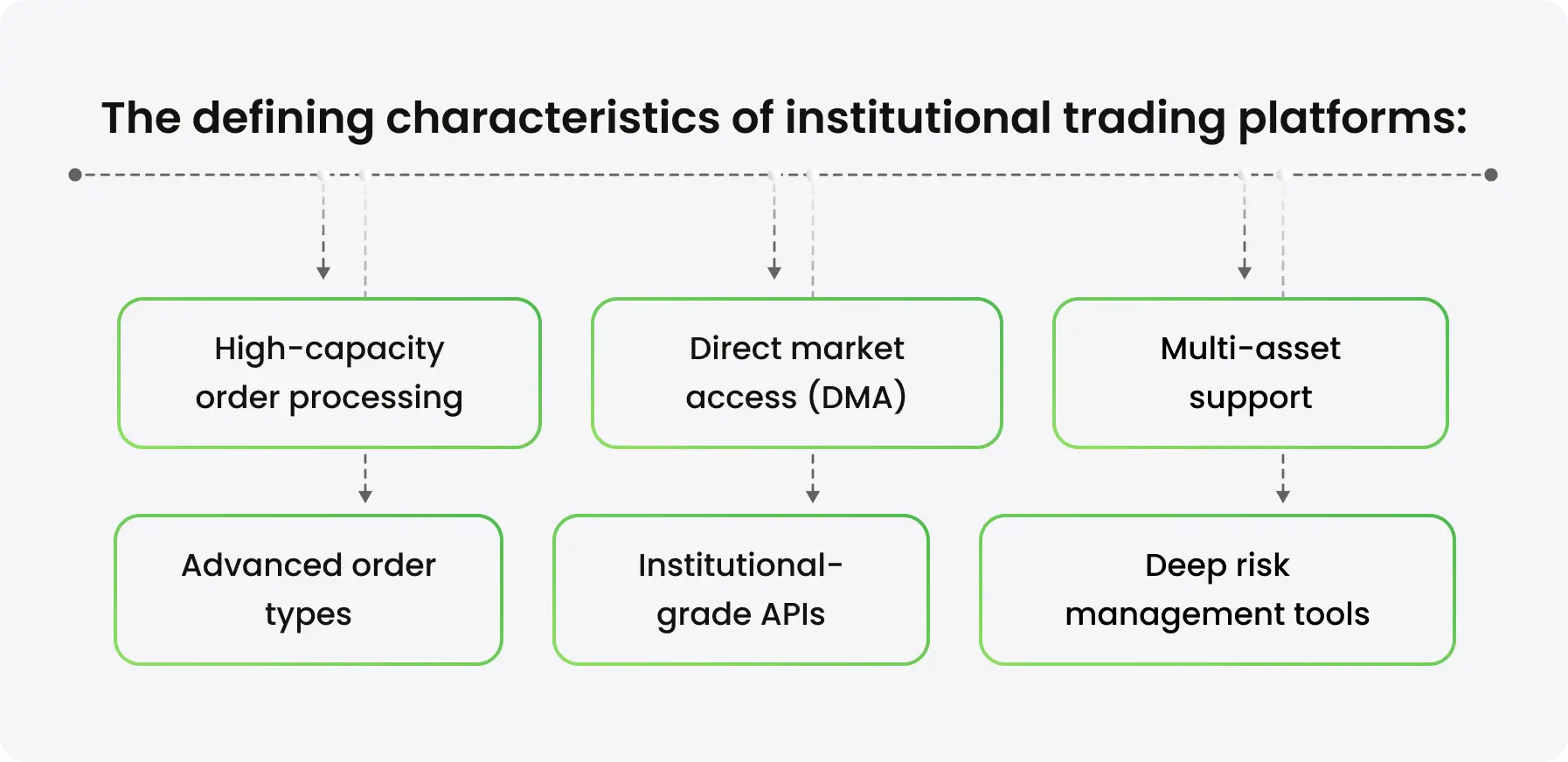
The defining characteristics of institutional trading platforms are:
- High-capacity order processing — ability to handle large order volumes with minimal latency
- Direct market access (DMA) — connectivity to liquidity pools without intermediary routing delays
- Multi-asset support — a single environment covering forex, equities, CFDs, futures, commodities, and crypto
- Advanced order types — iceberg orders, time-weighted average price (TWAP), volume-weighted average price (VWAP), and algorithmic execution strategies
- Institutional-grade APIs — FIX API, REST API, WebSockets for system-to-system connectivity
- Deep risk management tools — real-time exposure monitoring, margin controls, and position limits at the account and instrument level
Institutional vs. Retail Trading: Key Differences
The distinction between institutional and retail trading goes beyond order size. The differences run through every layer of how participants interact with markets, manage risk, and access technology.
| Institutional Trading | Retail Trading | |
|---|---|---|
| Order size | Millions to billions per transaction | Hundreds to thousands per transaction |
| Market access | Direct — interbank, prime brokerage, dark pools | Indirect — through a broker or dealer |
| Execution | Algorithmic, DMA, smart order routing | Manual or semi-automated via retail platform |
| Spreads | Raw or near-raw, often 0.0–0.1 pip | Marked up by broker, typically 0.5–2 pip |
| Technology | Bespoke or institutional-grade software, FIX API | Web/mobile retail platform |
| Data access | Level 2 depth of market, tick data, institutional feeds | Basic quotes and charts |
| Risk management | Firm-level exposure monitoring, real-time P&L | Per-account stop-loss and margin limits |
| Regulatory treatment | Professional client classification, different obligations | Retail client protections apply |
The critical implication for brokers: clients classified as institutional or professional expect a fundamentally different service model — and the technology stack needs to match those expectations from day one.
Who Uses Institutional Trading Platforms?
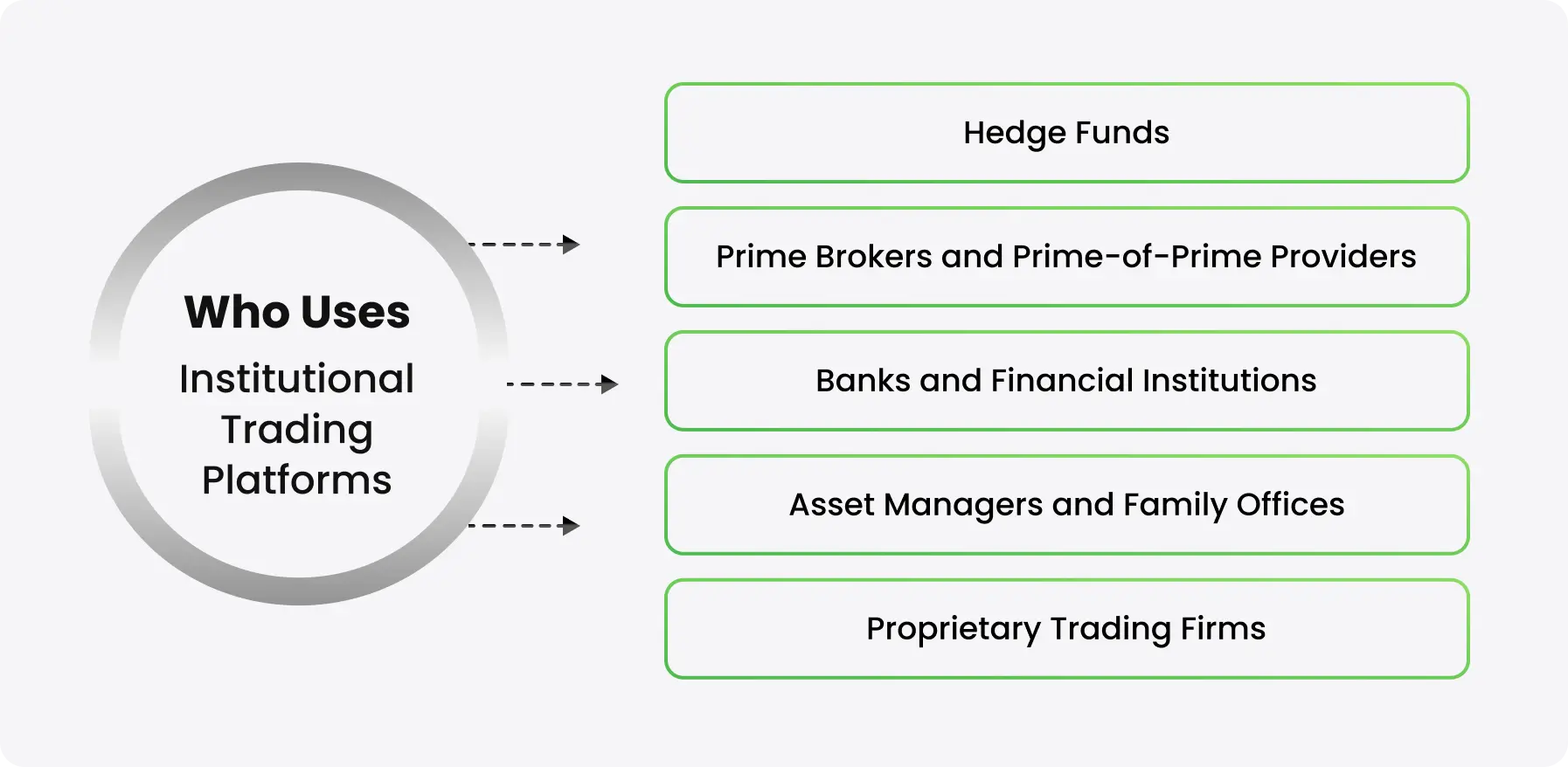
Institutional trading platforms serve a specific class of market participant. Understanding this client profile is essential for any broker building or selecting technology to serve them.
Hedge Funds
Hedge funds require platforms that support high-frequency execution, algorithmic strategies, and the ability to trade large blocks without moving the market. Features like iceberg orders, dark pool connectivity, and low-latency FIX API access are non-negotiable.
Prime Brokers and Prime-of-Prime Providers
Prime brokers act as intermediaries between institutional clients and liquidity pools, providing financing, clearing, and custody alongside trading infrastructure. A prime brokerage setup requires deep integration between trading platforms, risk systems, and back-office operations.
Banks and Financial Institutions
Banks trading on their own books or managing client portfolios need institutional trading software that can handle the regulatory complexity of institutional markets — real-time reporting, exposure limits, and audit trails that satisfy internal compliance teams and external regulators.
Asset Managers and Family Offices
Portfolio managers running multi-asset strategies need platforms with robust order management capabilities, multi-account allocation, and detailed performance reporting. For family offices managing private capital, the priority is often transparency and control over execution quality.
Proprietary Trading Firms
Prop trading firms deploy their own capital across strategies that demand speed, precision, and sophisticated risk management. They typically integrate directly into platforms via API, running algorithmic strategies that require tick-by-tick data and sub-millisecond execution. For brokers considering the white-label prop firm model, understanding this client profile is the starting point.
Core Features of an Institutional Trading Platform
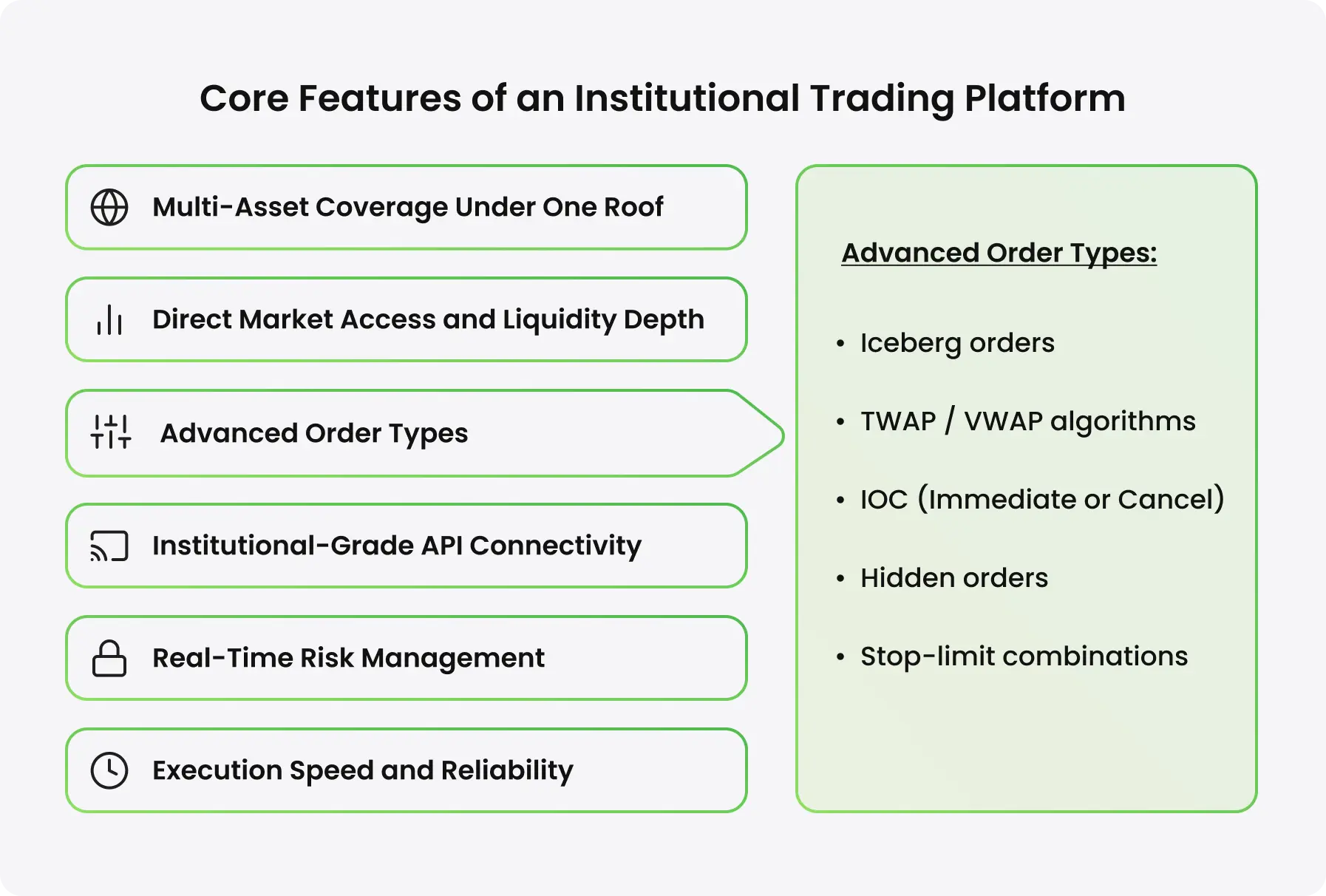
Not every platform marketed as "institutional" delivers the same depth. These are the features that genuinely separate institutional-grade infrastructure from retail platforms with a higher price tag.
Multi-Asset Coverage Under One Roof
Institutional clients rarely operate in a single asset class. A serious institutional trading platform supports forex, CFDs, equities, futures, ETFs, commodities, and crypto from a single account and interface. Forcing clients to switch between platforms for different instruments is a dealbreaker at the institutional level.
Direct Market Access and Liquidity Depth
DMA allows institutional traders to interact directly with the order book of an exchange or liquidity provider, bypassing intermediary handling. This matters for execution quality — DMA removes the latency and potential price manipulation that can occur when orders pass through multiple hands before reaching the market.
Alongside DMA, Level 2 market depth (full order book visibility) lets institutional traders assess liquidity before committing to a position, reducing market impact on large orders.
Advanced Order Types
Retail platforms offer market, limit, and stop orders. Institutional platforms go significantly further:
- Iceberg orders — display only a fraction of the total order size in the order book, concealing full position intent
- TWAP / VWAP algorithms — execute large orders gradually over time or at volume-weighted prices to minimise market impact
- IOC (Immediate or Cancel) — execute immediately or cancel the unfilled portion, essential for fast-moving markets
- Hidden orders — invisible to other market participants entirely
- Stop-limit combinations — precise risk control on entries and exits
Institutional-Grade API Connectivity
System-to-system integration is a baseline requirement for institutional clients, not an optional add-on. The standard is FIX API (Financial Information eXchange protocol), the industry-standard messaging format for securities transactions that virtually every institutional counterpart expects. REST API and WebSocket support round out the connectivity stack for modern integration patterns.
Real-Time Risk Management
At institutional scale, risk management must operate in real time across all open positions, instruments, and accounts simultaneously. This includes exposure limits by instrument and asset class, margin monitoring with automatic alerts or position reduction triggers, and consolidated P&L reporting across all accounts and sub-accounts. Retrospective risk reports are not enough — the system needs to flag and act on breaches as they happen.
Execution Speed and Reliability
Latency tolerance at the institutional level is measured in microseconds, not seconds. For high-frequency strategies, even a 10-millisecond delay can make the difference between a profitable execution and a missed opportunity. The infrastructure behind an institutional platform — co-location, matching engine architecture, network topology — determines its actual performance under real market conditions.
Execution Management Systems: The Engine Behind Institutional Trading
An execution management system (EMS) is the layer of institutional trading infrastructure that handles the actual placement and management of orders in the market. It sits between the portfolio management or strategy layer and the market itself, translating trading decisions into executed positions as efficiently as possible.
Key EMS functions include smart order routing (directing orders to the most favourable liquidity venue in real time), algorithmic execution strategies (TWAP, VWAP, implementation shortfall), transaction cost analysis (measuring and reporting the quality of execution after the fact), and real-time order tracking across multiple venues simultaneously.
For brokers building an institutional offering, the EMS is often the most technically demanding component to get right. The difference between a platform that merely supports institutional clients and one that genuinely serves them frequently comes down to EMS quality — specifically, how reliably it sources liquidity, how transparently it reports execution, and how flexibly it supports the algorithmic strategies professional clients rely on.
What Brokers Need to Know When Serving Institutional Clients
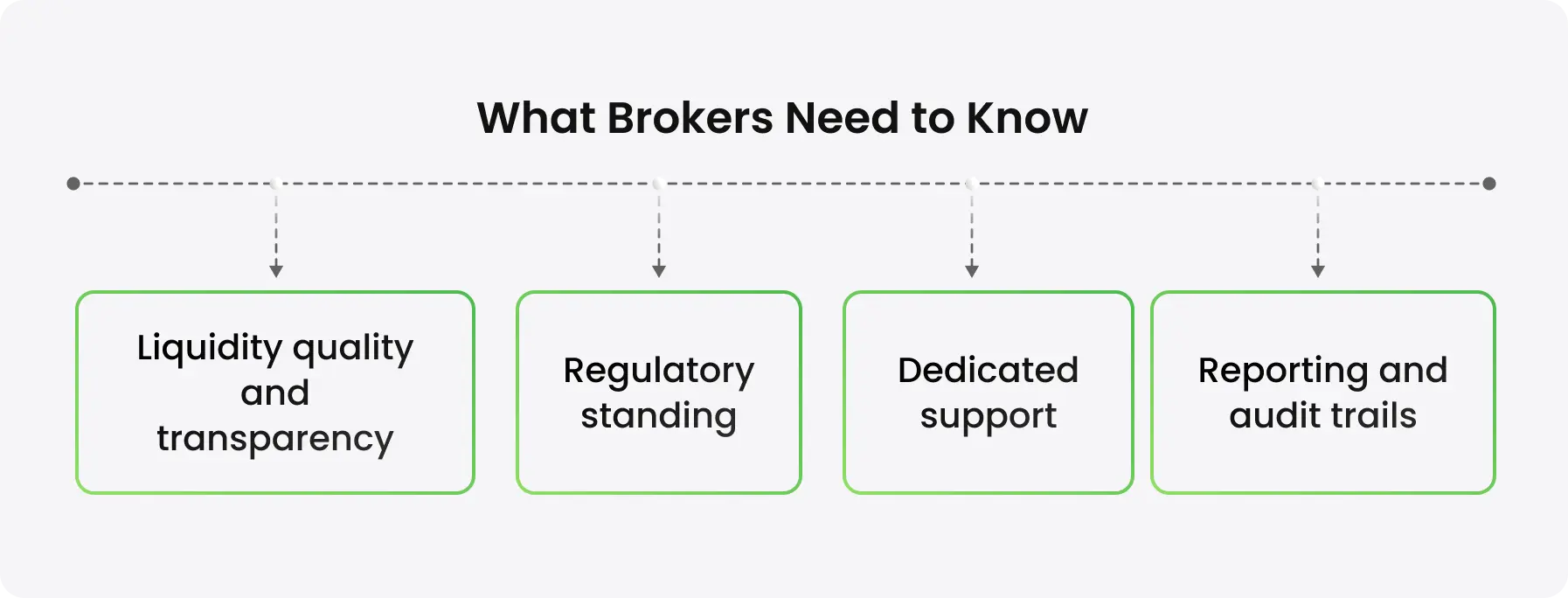
For brokerages looking to attract and retain institutional clients, platform capability is necessary but not sufficient. Institutional clients evaluate their counterparts on several dimensions beyond technology.
Liquidity quality and transparency. Institutional clients can tell the difference between genuine direct access to institutional liquidity and a retail feed dressed up with institutional branding. Transparency about liquidity sources, execution venues, and pricing methodology is expected and frequently audited.
Regulatory standing. Institutional clients typically operate under regulatory frameworks that impose obligations on who they can trade with. A broker without appropriate licensing in relevant jurisdictions will not pass counterparty due diligence regardless of how good the technology is.
Dedicated support. Institutional clients expect a dedicated relationship manager and technical support contact who understands their business, not a general support queue. The standard for response time on execution issues is minutes, not hours.
Reporting and audit trails. Regulatory obligations on institutional clients require detailed records of every trade, its execution quality, and the rationale behind order routing decisions. The platform must generate this data automatically and make it accessible in formats that feed into compliance workflows.
For brokers running their technology on TickTrader, these institutional requirements are built into the platform's architecture rather than bolted on as afterthoughts — covering multi-asset support, FIX API connectivity, advanced order types, and real-time risk management in a single integrated system.
How to Evaluate an Institutional Trading Platform
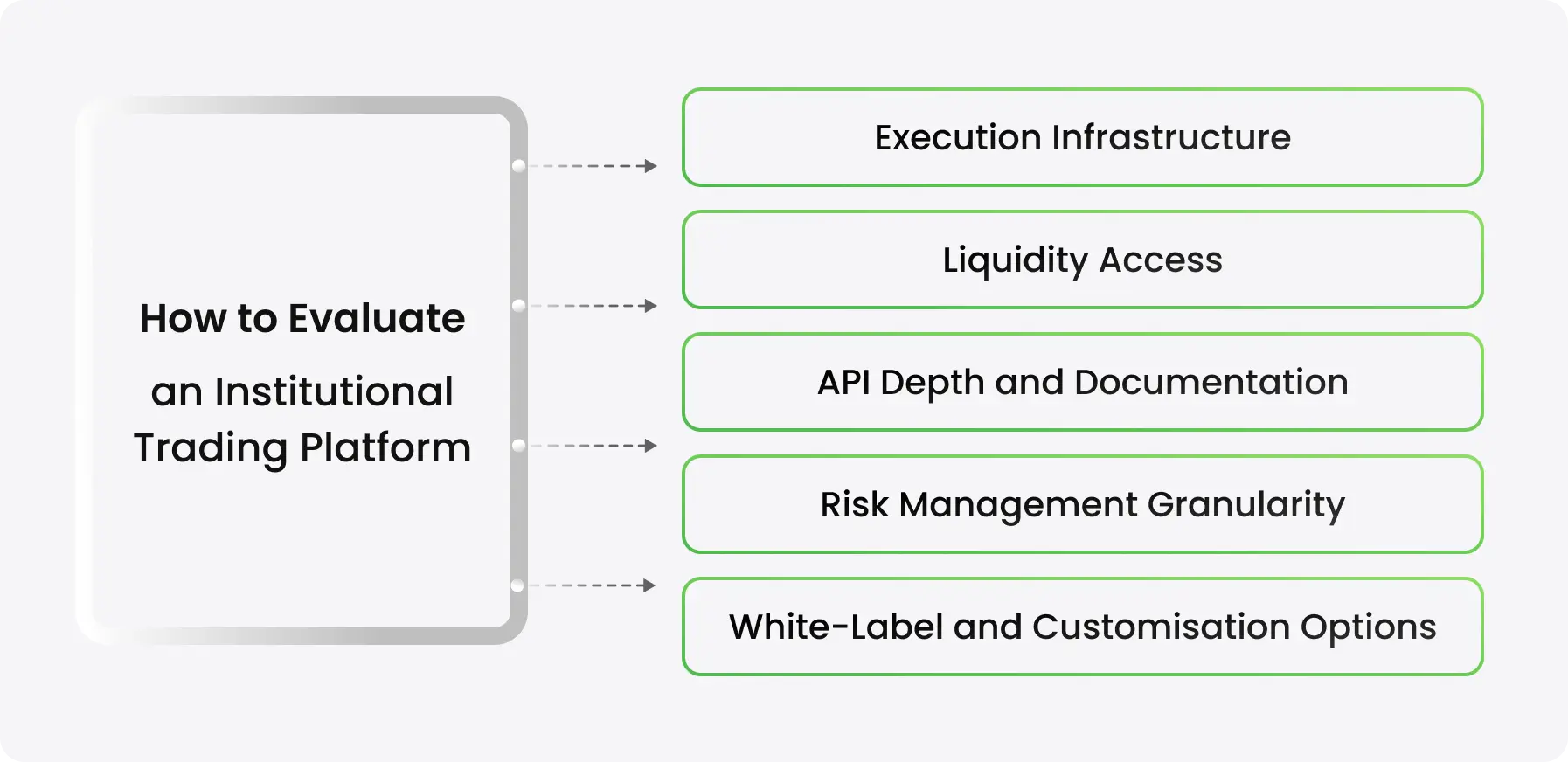
Choosing an institutional trading platform is a long-term infrastructure decision. The wrong choice creates technical debt, client churn, and operational risk that compounds over time. These are the criteria that matter most.
Execution Infrastructure
Ask about matching engine architecture, co-location options, and average order execution latency under load. Request data on uptime history and infrastructure redundancy. A platform that performs well in normal conditions but fails under peak volume is not suitable for institutional use.
Liquidity Access
Evaluate the depth and diversity of liquidity the platform connects to. Institutional clients expect access to multiple liquidity providers, the ability to compare execution quality across venues, and transparency about how their orders are routed. A liquidity aggregator that consolidates multiple sources into a single best-price feed is the standard expectation at this level.
API Depth and Documentation
FIX API support is the baseline. Beyond that, evaluate the depth of the API — whether it covers all order types, account management functions, and reporting endpoints — and the quality of documentation and developer support. Institutional technology teams will probe both.
Risk Management Granularity
Review how granularly risk limits can be set and monitored. Can limits be applied per instrument, per account, per strategy? Are breaches flagged in real time or discovered after the fact? Is position netting handled correctly across sub-accounts? These details matter enormously at institutional scale.
White-Label and Customisation Options
For brokers building an institutional offering rather than trading their own book, the ability to white-label the platform and customise the client-facing interface, reporting templates, and branding is important. A turnkey forex broker solution that includes institutional-grade technology with full white-label capability shortens time-to-market significantly compared to building custom infrastructure from scratch.
FAQ's
Q1: What is the difference between institutional and retail trading?
Institutional trading involves professional entities — hedge funds, banks, asset managers, prop firms — trading large volumes with direct market access, raw spreads, and sophisticated execution technology. Retail trading involves individual traders operating through a broker's platform with marked-up pricing and simplified execution tools. The distinction affects everything from the technology required to the regulatory framework that applies.
Q2: What is the best institutional trading platform?
The best institutional trading platform depends on the specific use case: asset class coverage, execution speed requirements, liquidity access, and integration needs. Key criteria are FIX API support, multi-asset capability, DMA access, real-time risk management, and proven latency performance under real market conditions. For brokers building their own institutional offering, platforms like TickTrader provide institutional-grade infrastructure in a white-label package.
Q3: What are execution management system vendors?
Execution management system (EMS) vendors provide the software layer that handles order placement, smart routing, algorithmic execution, and transaction cost analysis for institutional trading operations. Major categories include standalone EMS platforms integrated with third-party OMS systems, and fully integrated platforms where EMS and order management functions are combined. For brokers building institutional services, the EMS capability of the underlying trading platform is a critical evaluation criterion.
Q4: Do institutional trading platforms support algorithmic trading?
Yes — algorithmic trading support is a baseline expectation for institutional platforms, not a premium feature. This includes support for TWAP and VWAP execution strategies, API connectivity for running external algorithms, market-making algorithm support, and the ability to create synthetic instruments or custom indices. The depth and flexibility of algorithmic support varies significantly between platforms.